"Moving Therapy Moments" by Martina Schneider in Naturheilpraxis Magazine, January 2014
He has turned 60 years old. For 25 years he has worked as a naturopath, for 20 years with his own method, in which more than 6000 therapists have now been trained nationwide: Burkhard Hock has several reasons to celebrate - just hardly any time to do so.
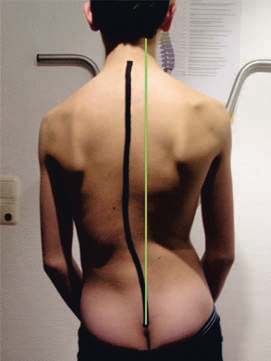
The concept of naturopath Burkhard Hock has one starting point: the tilted pelvis.
For the therapist from Bavarian Berchtesgaden, it is clear: "Problems with the hip, knee and spine, among others, are usually due to a pelvic obliquity." Its most common cause: a fall. Falling on one of the two ischial tuberosities causes the hip bone on the same side to rotate and the iliosacral joint (SI joint) to block.
"What is important," says Hock, "is that correction is made as quickly as possible; otherwise the spine, controlled by the cerebellum and cerebrum, begins to bring the head to the center of the body." This compensation is called simple or multiple convex scoliosis.
The next complaints and diseases are now programmed: All muscles leave their physiological length - "there are only muscles that are too short and too long" - leading to disc misalignments, protrusion and prolapse, facet syndrome, chronic pain in the lumbar spine area or on one hip side, muscle tension, sciatica, restricted movement.
The story of the Hock Method begins with an encounter with a doctor. He tells the orthopedically oriented naturopath about Dieter Dorn and his therapy, Hock books a seminar with Dorn.
17 years ago, Hock began finding evidence in a radiological practice: "I examined patients whose pelvises were to be X-rayed; in none of these patients was a subluxated hip joint visible despite leg length differences," explains the naturopath. He was allowed to continue researching at the anatomy department of the University of Munich.
His therapy method for correcting pelvic obliquities he first called the Dorn-Hock Method.
This has been different for five years when the Hock concept was born: "We worked in a team with four physiotherapists on methods to move away from the standing position of the patient when treating the spine."
Recommended Book
The Stretching Book
View now →
With every muscle that is too short, explains the 60-year-old, the internal pressure in the joint it spans increases, "and thus the risk of developing osteoarthritis." His goal: muscles that are mobile and dynamic and thus best serve human health.
"His conclusion: First you become stiff, then old. Those who have dynamic muscles instead, that is, strong and stretched muscles, have provided for their life.

Recommended Book
The Orthopedic Home Pharmacy
View now →
Image Gallery